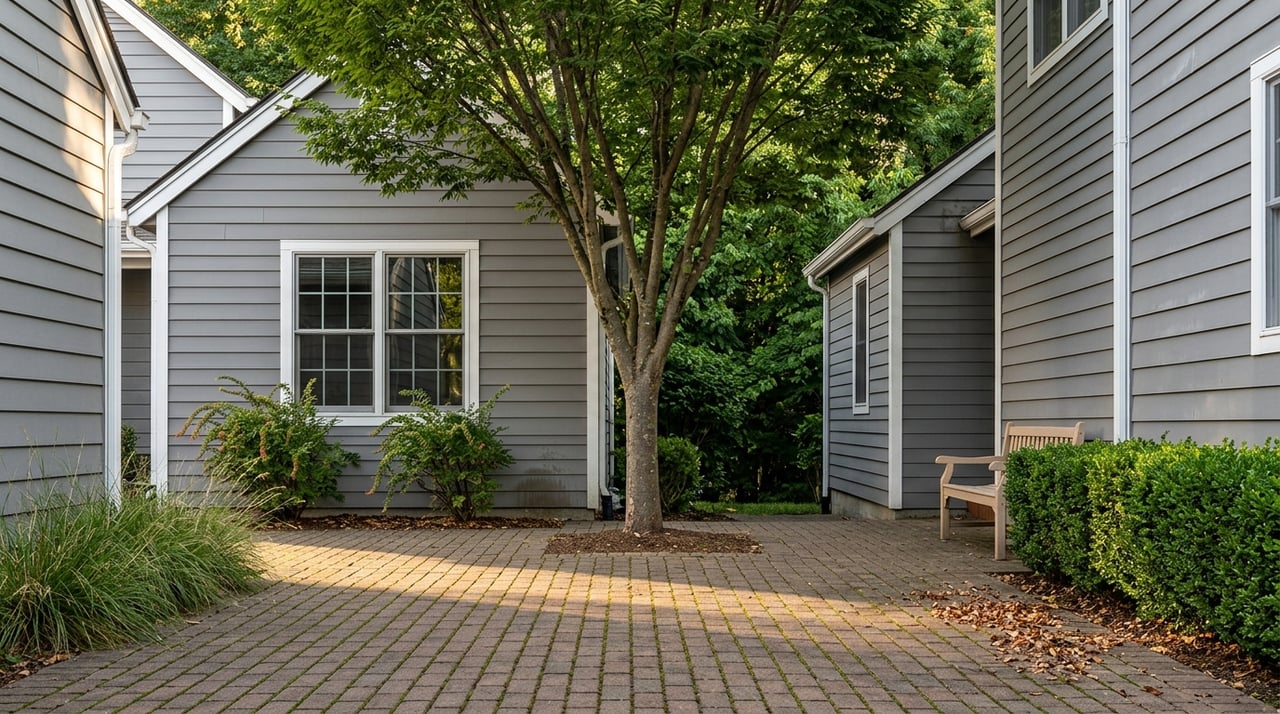
RELAC Is Gone. In Lake Anne, the Real Question Now Is Timing, Not Cost.
Walk into a Quayside condo at Lake Anne Plaza this month and you will likely hear the same line from the listing agent: the deed restriction on individual air conditioning is over, so cooling is no longer a problem. That is true, but it skips the part that actually determines when a buyer can turn on a compressor. For sixty years, homes around Lake Anne Plaza were tied to a single shared cooling utility, and its shutdown did not hand every owner the same path forward. It handed different owners different paths, on different timelines, and the difference has almost nothing to do with the retrofit price tag everyone quotes.
If you are buying or selling in the clusters and buildings that once relied on that system, the number that matters most on closing day is not the cost of a mini-split. It is the status of a Design Review Board application you may never have heard of.
The Reston Lake Anne Air Conditioning Corporation, known locally as RELAC, chilled water pulled from the lake and circulated it to more than 600 homes and businesses starting in 1965. It was a genuinely novel idea for its era. It also aged the way 1960s mechanical infrastructure ages: rising electrical costs, failing pumps, and a shrinking customer base that made the math stop working. A resident-led nonprofit called springRELAC, founded by Simon McKeown, tried to take over the utility as a cooperative in 2024. McKeown died unexpectedly that December, and the rescue effort did not survive him. By October 2025, RELAC's remaining owners announced they would permanently cease operations.
That announcement created a legal knot. Reston Association's deed had long prohibited individual AC units in RELAC-served properties, on the theory that central cooling was already available. Once RELAC stopped delivering water, that theory no longer held, but RA spent weeks confirming the utility's status with the State Corporation Commission before it would act. The board finally voted on December 11, 2025 to stop enforcing the covenant, citing "impossibility." The deed language itself was not erased. RA simply directed staff to stop enforcing it.
As of this spring, RA reported it had received more than 80 individual air conditioning applications from owners in the affected clusters since January 1, 2026, according to the association's own RELAC page. That is the visible part of the story. The part that matters more for a transaction is who gets to file one of those applications on their own, and who has to wait on someone else.
RELAC served a mix of property types, and Reston's design review process treats them differently. Townhome cluster owners, in places like Hickory, Waterview, Washington Plaza, Wainwright, Coleson, and Governor's Square, generally own their own exterior walls and can apply to the Design Review Board individually, working with their cluster association on placement and noise standards. Condominium owners in buildings where the exterior belongs to everyone, not to any single unit, cannot. Their association has to file on the building's behalf, because the compressor and lines almost always sit on what condo law calls a limited common element rather than anything the individual unit owner controls outright.
That distinction is why a Hickory Cluster homeowner and a Heron House condo owner, both served by the same defunct utility, are living through completely different springs.
| Property type | Examples | Who applies to the DRB | Status as of spring 2026 |
|---|---|---|---|
| Townhome cluster | Hickory, Waterview, Washington Plaza, Wainwright, Coleson, Governor's Square | Individual homeowner, coordinating with the cluster association | Applications processing directly; a Hickory Cluster unit was approved by the DRB on March 24, 2026 |
| Condominium (LARCA) | Heron House, Chimney House, Quayside | Lake Anne of Reston Condominium Association, filing jointly for owners | Concepts presented to the DRB in February 2026, formal application filed April 21, 2026, aiming for one building-wide solution |
| Condominium | Vantage Hill | Vantage Hill Condominium Unit Owners Association | Formal application filed April 21, 2026; the association's own materials put full completion at spring 2027 |
The townhome path is already producing real, granular approvals. The March 24, 2026 DRB minutes for that Hickory Cluster unit specify the exact model, a 3-ton Goodman condenser rated at a maximum of 68 decibels, mounted on a weathered wood platform with neoprene pads, with any exposed conduit painted to match the surrounding structure. That is the level of detail RA is now applying to individual installs, and it is a useful preview for any townhome buyer wondering what their own application will involve.
The condo path is a different animal entirely. LARCA's proposal for Quayside and Chimney House involves rooftop units or heat pump fixtures designed, according to the firm presenting the plan, to have minimal visible impact on the buildings as seen from the plaza. Vantage Hill's board has been open that its project, which includes electrical upgrades needed to support the new load, is still moving through design and permitting and is not expected to finish until spring 2027, more than a year after RELAC shut off the water.
One of the consultants working on the Vantage Hill project put the stakes plainly to the board:
"We want to try to make it as least impactful on everyone as possible, especially the lower-level owners, who have patios outside."
That is not a comment about cost. It is a comment about a building trying to get one design right for dozens of owners at once, which takes months longer than one owner getting one unit approved for one patio.
A buyer touring a Reston resale this fall needs to ask a different question depending on the building. In a townhome cluster, the question is mostly financial: has this unit already been retrofitted, and if not, is the seller willing to credit any of the cost. Retrofits in units without existing ductwork, which describes a lot of Lake Anne's original housing stock, commonly run in a wide range depending on system type, and that is a conversation for your own HVAC quotes rather than a number to take on faith from a listing sheet.
In a LARCA building or Vantage Hill, the question is about timing and governance, not just money. Has the building's joint application actually been approved, or only proposed? If approved, has installation started, or is the unit still waiting on an electrical upgrade the way Vantage Hill residents are? Will the retrofit be paid through individual owner assessments, a broader capital special assessment, or some mix the association hasn't finalized yet? None of that shows up in a walkthrough. It shows up in association meeting minutes and in the resale disclosure packet.
Before writing an offer, or before you list a unit in one of these buildings, pull together the following:
Does this affect every home in Reston? No. RELAC served a defined set of properties around Lake Anne Plaza, roughly 600 in total between townhomes, condos, and a handful of commercial units. Homes outside that service area were never subject to the covenant and have no retrofit question to ask.
Is the AC ban actually gone from the deed? Not literally. RA's board voted in December 2025 to stop enforcing that section of the deed because the utility it depended on no longer exists. The language itself is still on the books, but staff have been directed not to act on it.
If I'm buying in Hickory or Waterview, is my work done once I confirm the cluster allows individual units? Not quite. Approvals are still issued unit by unit, with specific conditions on equipment size, noise limits, and screening. Confirm the status of the actual unit you're buying, not just the general policy for the cluster.
RELAC's story is Reston's own, and it says something true about a community built around shared infrastructure: when that infrastructure ages out, the fix rarely arrives on the same day for everyone. If you are weighing a purchase or a sale in one of these buildings, get the specific timeline in writing before you get attached to a closing date. Eve Thompson has spent two decades watching Lake Anne's governance evolve up close, and All Reston Real Estate can help you read a resale packet the way someone who lives here reads it. Reach out for a free home valuation and a straight answer on where your building actually stands.
Stay up to date on the latest real estate trends.


Get assistance in determining current property value, crafting a competitive offer, writing and negotiating a contract, and much more. Contact me today.
EVE THOMPSON OF COMPASS
11943 Democracy Drive Reston, VA 20190